.png)
Farmer’s Forum & Appreciation Event: What We Heard, What We Learned, and Where the Conversation Is Going

On January 22, 2026, the Kimberley Cranbrook Food Network (KCFN) hosted a Farmer’s Forum & Appreciation Event at the Manual Training School at the Cranbrook Public Library. The gathering brought together local farmers, food producers, school food coordinators, funders, and community organizations to share information, ask real-world questions, and take part in open, solution-focused dialogue around local food security in our region.
Throughout the day, one thing became clear: many people in our region are working toward similar goals, often facing similar challenges — and there is real value in creating space to learn from one another and find ways to better connect the dots together across our region.
Below is a summary of the key topics shared at the forum, along with links and context for anyone who wasn’t able to be in the room (or for those who were there and would appreciate a recap of the engaging day).

Why We Came Together
The Farmer’s Forum was designed with a few shared intentions:
To bring together farmers, food producers, and food security organizations rooted in the Kimberley–Cranbrook region, with connections extending across the Kootenays and beyond
To better understand shared challenges and emerging opportunities facing farmers and ranchers locally, and to explore how regional collaboration can support practical solutions
To co-create pathways forward by sharing information, resources, and lived experience from across the local and regional food system
The format emphasized open dialogue — combining presentations, Q&A, networking, and rotating breakout discussions — to ensure information flowed both ways. We’ve summarized key highlights and takeaways from the day below, but for anyone who’d like to dig a bit deeper, a PDF of the presentation slides is also available (please keep in mind that these slides are supporting visuals only and don’t reflect the full conversations and context shared during the forum).

Feeding Futures, School Food, and Institutional Procurement
School food coordinators Vincent Girimonte from School District 5 - Southeast Kootenay and Eric Larocque from Rocky Mountain School District No. 6 opened the forum by sharing how Feeding Futures funding and the National School Food Program are being implemented locally.
Key context shared included:
Feeding Futures represents the largest investment in school food programs in B.C.’s history and is now considered dedicated, ongoing funding, providing greater stability for long-term planning and partnerships
The Province has set a 30% B.C. food procurement guideline for K–12 schools — this is a guideline, not a mandatory requirement, and districts are encouraged to work toward it in ways that make sense locally
Clear definitions matter when discussing procurement and tracking progress:
B.C. food refers to food produced and/or processed within British Columbia
Local food refers to food produced within the region
Hyperlocal food refers to food produced within the same community where it is consumed
School districts are balancing real-world constraints — including seasonality, supply consistency, staffing capacity, storage, transportation, food safety requirements, and cost — while also identifying meaningful opportunities to strengthen relationships with local producers
The importance of partnership-based approaches was emphasized, particularly where collaboration with food recovery organizations, community kitchens, and regional suppliers can help bridge gaps
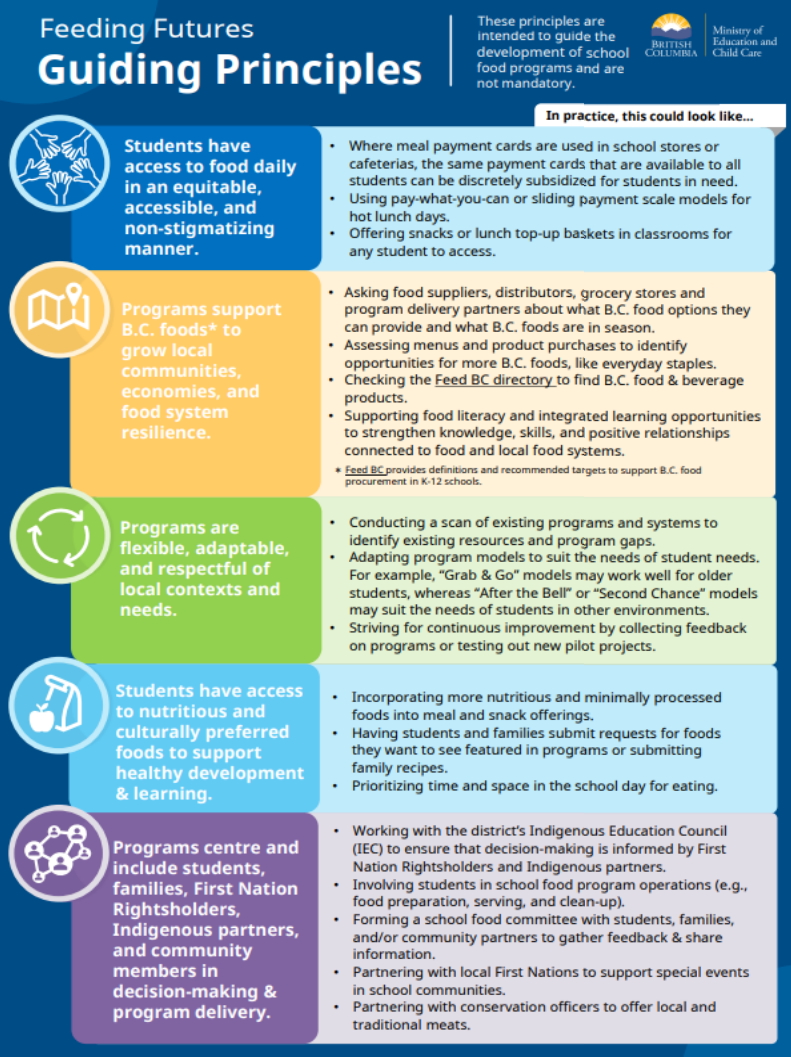
Examples were shared from both districts, including breakfast and lunch programs, partnerships with food recovery organizations, and pilot initiatives exploring more coordinated purchasing and distribution models. In some cases, these partnership-based approaches have already resulted in districts exceeding the 30% B.C. food procurement guideline — demonstrating that progress is possible when relationships, infrastructure, and coordination align. These examples highlighted that progress toward local procurement often happens incrementally, through relationship-building and creative problem-solving rather than one-size-fits-all solutions.
For more information:
Province of B.C. – Feeding Futures: https://www2.gov.bc.ca/gov/content/education-training/k-12/administration/program-management/feeding-futures/feeding-futures
National School Food Program (Government of Canada): https://www.canada.ca/en/employment-social-development/programs/school-food.html
Feed BC producer and processor resources: https://www2.gov.bc.ca/gov/content/industry/agriculture-seafood/growbc-feedbc-buybc/feed-bc-and-the-bc-food-hub-network/producer-and-processor-resources

Subsidies, Supports, and Building Capacity
This session focused on the supports available to farmers and food producers, and the important role community organizations play in strengthening regional food systems — not just through funding, but through coordination, capacity building, and long-term relationship-based work.
Tracey Amy from United Way BC shared how food security fits within their broader poverty reduction and community impact work, including:
Investment in Regional Community Food Hubs across B.C. to improve coordination and reduce duplication
Support for shared infrastructure such as kitchens, storage, and transportation
A collaborative, community-led approach that aims to move beyond crisis response toward long-term resilience

Kerstin Renner from Community Futures East Kootenay then provided an overview of supports available to farmers as business owners, including:
Small business loans and developmental financing
What lenders look for (capacity, planning, cash flow, and risk)
The importance of business structure, realistic projections, and long-term viability

Together, these presentations sparked discussion about how information about supports is shared, how accessible it feels on the ground, and where clearer pathways and communication could make a real difference for farmers navigating complex systems.
Other Farming Resources Shared at the Forum
In addition to the presentations, a number of practical resources and programs were highlighted during the day and in follow-up conversations. These are included here as a starting point for farmers and producers looking to explore available supports, such as:
Small Scale Meat Producers Association: Offers advocacy, resources, and potential supports related to slaughter, processing, and small-scale meat production (CLICK HERE FOR MORE INFO).
Basin Business Advisors: Provides on-demand agriculture and small business courses relevant to producers in the Columbia Basin (CLICK HERE FOR MORE INFO)
Young Agrarians: Offers land-matching programs and supports for new and young farmers.(CLICK HERE FOR MORE INFO).
School District 5 Southeast Kootenay – Field Trip Opportunities: Information was shared about potential farm-based field trips and partnerships with schools. There may be opportunities for groups of farmers to collaborate on education-focused initiatives (CLICK HERE FOR MORE INFO).
United Way BC also noted they are exploring options related to school credits and student volunteer placements with farmers and producers. Further information will be shared as it becomes available.

Columbia Basin Trust
Food Producer Wage Subsidy & Training Support (CLICK HERE FOR MORE INFO)
Grassland and Rangeland Enhancement Program (CLICK HERE FOR MORE INFO)
Resilient Food Crops Grants (CLICK HERE FOR MORE INFO)
Community Futures East Kootenay
Small Business Loans (CLICK HERE FOR MORE INFO)
United Way BC
Work Experience Opportunities Grant (requires partnership with a non-profit) (CLICK HERE FOR MORE INFO)
British Columbia Ministry of Agriculture: Hosts a central listing of provincial agriculture programs and services. Their newsletter often includes opportunities from multiple organizations, not just the Ministry. (CLICK HERE FOR MORE INFO)
Investment Agriculture Foundation of BC
Beneficial Management Practices (BMP) Program (application windows opening soon - CLICK HERE FOR MORE INFO)
Requires completion of an Environmental Farm Plan (EFP) as a first step (CLICK HERE FOR MORE INFO).
Alternative Retail Methods and the “Missing Middle”

The afternoon presentations shifted toward market access, distribution, and regional food infrastructure.
Damon Chouinard from Grow & Connect introduced their pilot project focused on strengthening regional food systems across the Kootenays by improving coordination, visibility, and shared logistics between producers, processors, distributors, and buyers. Their presentation framed regional food infrastructure as a key piece of long-term food security — particularly for farms and food businesses operating at a commercial scale but outside of industrial supply chains.
The presentation explored:
How mid-scale producers often fall into the “missing middle” — too large for direct-to-consumer markets, but too small to easily access conventional wholesale and institutional supply chains
Why regional coordination and shared infrastructure (including transportation, storage, aggregation, and distribution) are critical for farmer viability, food system resilience, and keeping food dollars circulating locally

How alternative food networks — such as food hubs, institutional buyers, and regional wholesale relationships — can work more effectively when connections and communication are strengthened
How Grow & Connect’s pilot project is testing practical, business-to-business tools (including a regional directory and shared logistics features) to help producers, processors, distributors, and buyers find one another, coordinate resources, and explore collaboration across the Kootenays and beyond (CLICK HERE FOR MORE INFO)

Cranbrook Food Innovation Centre: Exploring New Possibilities
Sophie Larsen from Community Connections Society of Southeast BC shared updates on the upcoming Cranbrook Food Innovation Centre, a community-focused facility designed to support food recovery, processing, storage, aggregation, and education.
Key points included:
The centre will include commercial kitchen space, storage, and shared infrastructure
It aims to support both community food access and connections with local producers
Multiple distribution and retail models are being explored — and producer input will directly shape whether and how these models move forward

A key focus of the conversation around the Cranbrook Food Innovation Centre was gathering farmer and producer feedback on the possibility of using some of the space to support alternative distribution and bulk purchasing models. The team is currently exploring the feasibility of a community-based approach that could better support local producers, improve food access, and strengthen regional food distribution in ways that are practical, fair, and sustainable.

To continue the dialogue beyond the forum, farmers and producers are encouraged to complete a short, optional survey that helps identify what’s working now, where challenges exist, and which models could be most useful. All responses are anonymous, and there’s an option to be contacted for a follow-up conversation if you’d like.
👉 Complete the survey here: https://www.surveymonkey.com/r/375RV27
From Challenges to Solutions: Breakout Conversations

The forum concluded with rotating breakout discussions that allowed participants to dig deeper into shared challenges and opportunities, including:
Barriers to entry in agriculture and food production, including community education and youth engagement
Navigating subsidies and supports, with a focus on access, clarity, timing, and communication
Alternative retail and distribution methods for getting local products to market
Institutional procurement and regional coordination, including the role of government policy and public institutions
These conversations were marked by honesty, curiosity, and respect. Common themes included the need for clearer communication pathways, better coordination around distribution and logistics, and greater shared understanding between institutions, support organizations, and producers. Participants also highlighted the value of learning what others are already working on, where efforts overlap, and how collaboration could help move ideas from discussion toward action.
Gratitude and Looking Ahead

The day was grounded in community from start to finish — with coffee and treats from Max’s Place and a healthy, hearty lunch provided by Cranbrook Food Recovery, connecting directly back to earlier conversations about school food programs and local procurement.
We’re deeply grateful to United Way BC for the funding support that made this event possible, and to everyone who helped organize, present, and participate. This forum wasn’t about arriving at quick answers — it was about building shared understanding, strengthening relationships, and continuing the dialogue.
For farmers and producers who want to stay informed about funding opportunities, program announcements, and regional supports, it’s recommended to sign up for a few key newsletters that regularly share timely information:
British Columbia Ministry of Agriculture newsletter: https://confirmsubscription.com/h/y/0306FA93C83E9C3E
Kootenay & Boundary Farm Advisors newsletter: https://kbfa.us17.list-manage.com/subscribe?u=ee0b66c1606395a88e035e8c7&id=44647fdedc
Investment Agriculture Foundation of BC newsletter: https://iafbc.ca/newsletter/
And a reminder that community supports are there to be used — sometimes a phone call can save a lot of internet searching. Farmers are encouraged to reach out to:
Jeff Nimmo, Regional Agrologist (Kootenays), B.C. Ministry of Agriculture & Food | 📞 778-666-0568 | ✉️ jeffrey.nimmo@gov.bc.ca
Kootenay & Boundary Farm Advisors | 📞 778-771-5851 or 1-800-958-7174 (toll-free) | ✉️ coordinator@kbfa.ca
Finally, as part of continuing the momentum from the forum, KCFN is exploring the creation of an open, opt-in directory of farmers, ranchers, and community organizations who are interested in staying connected and continuing conversations around regional food security. If you’d like to be included — and give permission for your information to be shared with others in the network — you can fill out the directory form here!
And if you’d like to stay connected more broadly, learn more about the Kimberley Cranbrook Food Network, or explore the organizations that make up our network, visit our Who We Are page and follow us on Facebook and Instagram… and please share this information with any other local area farmers and producers that you think would be interested in learning more!
We look forward see what grows from the local food connections being planted! 🌱


Comments